
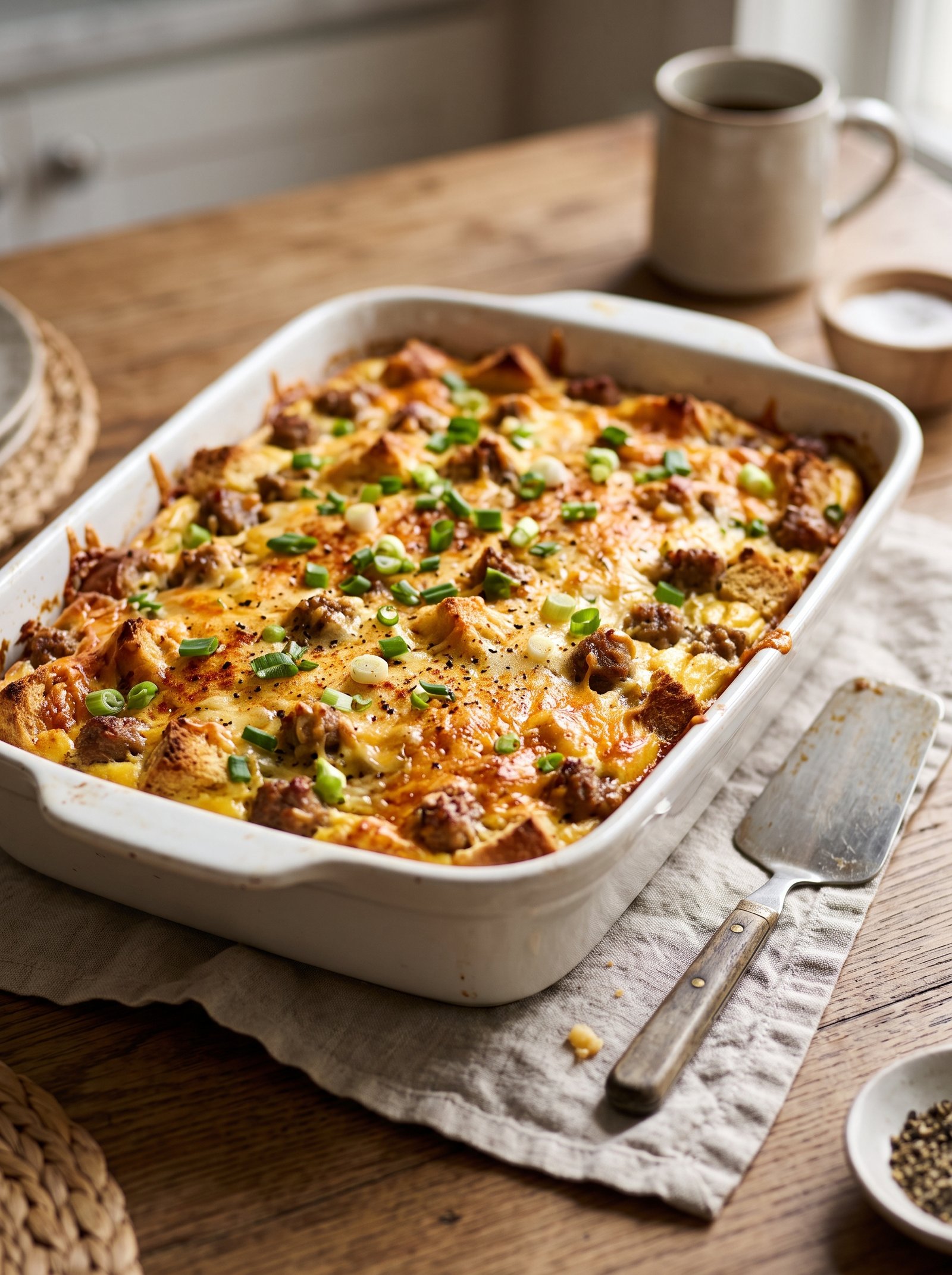
My grandmother always believed that the gathering of family required a centerpiece that commanded attention, offering both warmth and deep sustenance. I vividly recall the crisp December mornings in her meticulously organized kitchen, where the scent of browned pork and toasted sourdough filled the air long before the sun crested the horizon.
She approached cooking with an almost scholarly precision, measuring her custard ratios with a careful eye and teaching me the fundamental principles of culinary chemistry. Her methodical approach transformed simple ingredients into something transcendent.
Over the years, I have refined her techniques, applying modern culinary science to her traditional framework. This journey has led me to perfect the ultimate Sausage, Egg & Cheese Breakfast Casserole, ensuring every layer achieves structural integrity and robust flavor without fail. Let us dig into this methodology together!
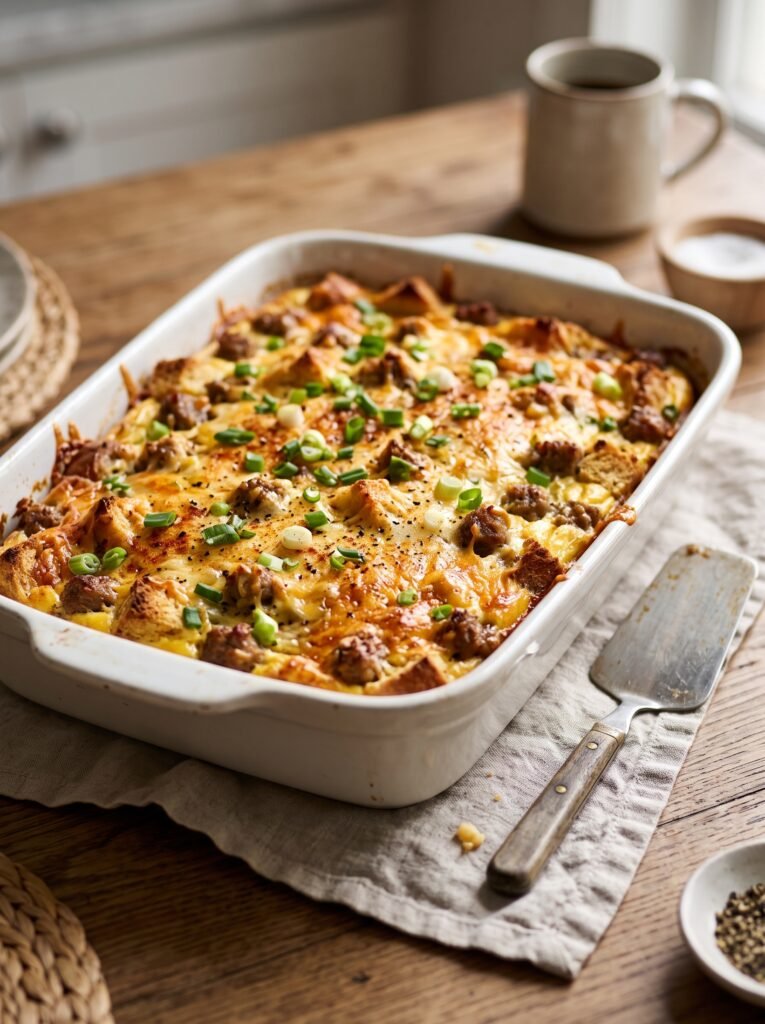
The Ultimate Sausage, Egg & Cheese Breakfast Casserole (Make-Ahead & Easy)
Part 1: Why This Sausage, Egg & Cheese Breakfast Casserole Is the Ultimate Crowd-Pleaser
The Perfect Balance of Savory Sausage, Fluffy Eggs, and Gooey Melted Cheese
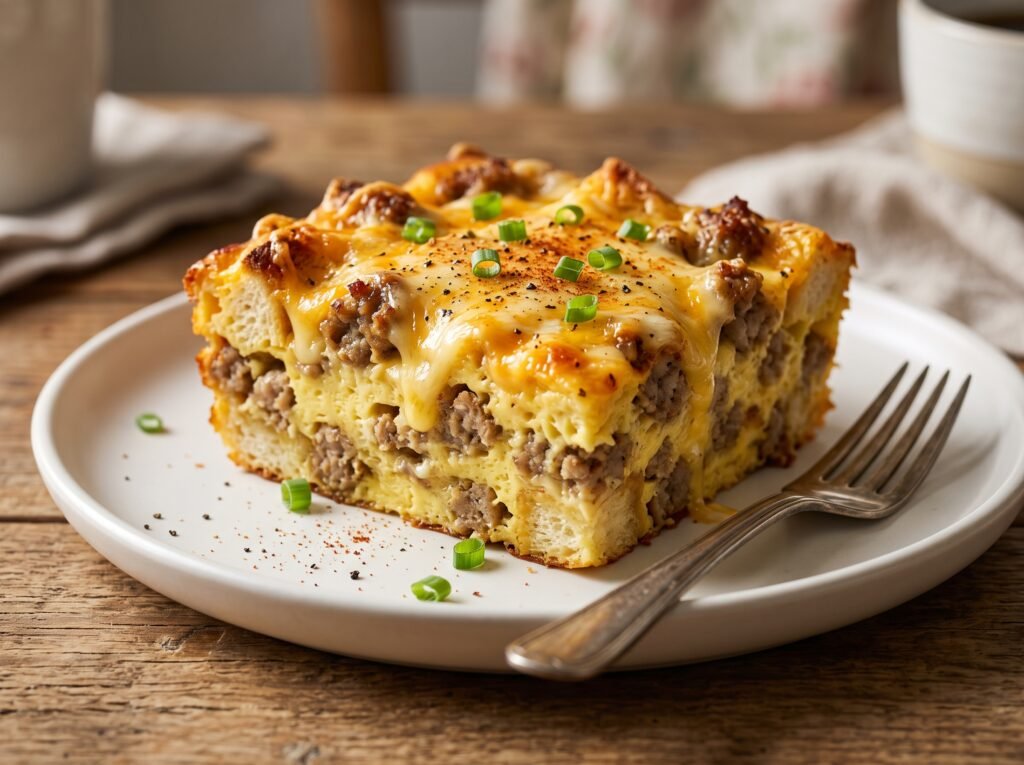
When evaluating morning meal options, one must carefully consider the delicate interplay of macronutrients and flavor profiles. The structural foundation of this Sausage, Egg & Cheese Breakfast Casserole relies on a harmonious triangle of proteins, fats, and carbohydrates. Savory ground meat provides an umami-rich baseline, anchoring the lighter, aerated texture of the whisked eggs. Simultaneously, the lipid content from the melted dairy encapsulates the bread, preventing it from desiccating during the baking process. I think it is amazing to observe how these distinct components undergo complex Maillard reactions in the oven, culminating in a cohesive, sliceable structure that appeals universally to diverse palates.
An Essential Recipe for Holiday Brunches, Christmas Morning, and Meal Prep
Planning a substantial morning feast often introduces unnecessary stress, particularly during significant family gatherings or busy professional weeks. Implementing a reliable, large-format Sausage, Egg & Cheese Breakfast Casserole drastically reduces active cooking time when you need it most. Through my experience hosting extensive holiday affairs, I have found that preparing a unified dish streamlines kitchen logistics flawlessly. Rather than managing multiple skillets and monitoring individual portions, one single baking vessel handles the caloric requirements for an entire household. Furthermore, this method translates seamlessly into weekly meal preparation, allowing busy individuals to portion and store nutrient-dense squares that maintain their integrity throughout the workweek.
Why Baking as an Overnight Breakfast Strata Enhances Flavor and Texture
Time is an essential, yet frequently overlooked, ingredient in advanced culinary applications. By assembling the components in advance and utilizing refrigeration, you initiate a slow-soak hydration process crucial for any overnight Sausage, Egg & Cheese Breakfast Casserole. The starches within the bread structure gradually absorb the seasoned liquid, ensuring complete saturation without cellular breakdown. I have noticed that this prolonged resting period allows the fat-soluble flavor compounds from the meat and dairy to permeate the entire matrix evenly. Consequently, when the vessel finally enters the heated oven, the resulting texture is incredibly uniform, exhibiting a luxurious, custard-like crumb rather than a segregated appearance.
Part 2: Essential Ingredients and the Science of the Custard Ratio
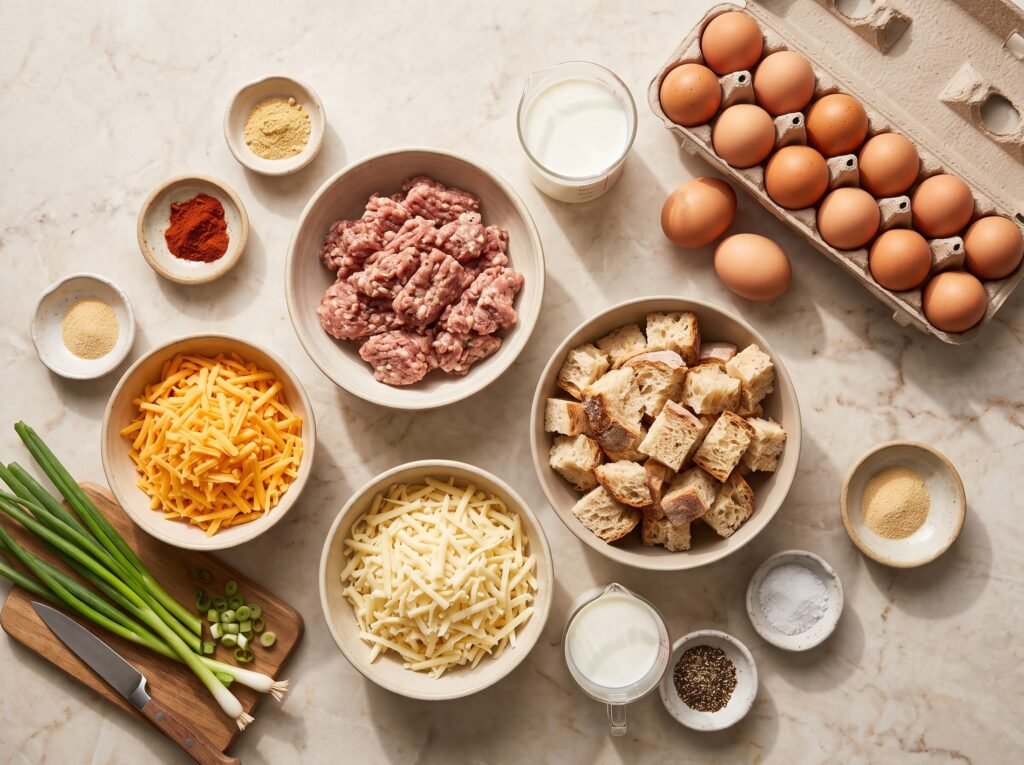
Choosing the Best Sausage: Mild Country Pork, Spicy Italian, or Lean Turkey
The selection of your primary protein dictates the foundational flavor profile of your entire Sausage, Egg & Cheese Breakfast Casserole. Traditional mild country pork offers a quintessential, sage-forward aromatic experience that resonates with classic American morning traditions. However, I often experiment with spicy Italian varieties when I desire a more robust complexity to counteract the richness of the dairy. For those who traditionally favor a classic ham and cheese casserole, transitioning to lean poultry sausage provides excellent protein density with a similar savory profile. When utilizing leaner meats, I highly recommend incorporating a marginal amount of supplementary lipid to prevent a dry mouthfeel.
The Golden Ratio of Eggs to Milk: Preventing a Rubbery or Soggy Bake
Precision in formulating your liquid base prevents the two most common structural failures in strata preparation: the dreaded weeping liquid and the unpalatably dense, rubbery texture. After conducting numerous trials in my own kitchen, I advocate for a strict scientific ratio for this Sausage, Egg & Cheese Breakfast Casserole. This specific proportion guarantees that the proteins coagulate gently, trapping moisture within a delicate lattice. Introducing excess liquid overwhelms the bread’s absorptive capacity, while a deficiency yields a tough, sulfurous result. Maintaining this scientific balance is absolutely paramount for a superior gastronomic outcome. I have summarized the optimal ratios in the table provided below for your reference.
| Ingredient Category | Optimal Measurement | Culinary Purpose |
| Large Eggs | 8 to 10 Whole Eggs | Provides primary structural coagulation and rich flavor. |
| Liquid Dairy | 2 Cups Whole Milk | Hydrates the carbohydrates and tenders the protein lattice. |
| Dry Carbohydrates | 6 Cups Cubed Bread | Absorbs the custard to create the necessary scaffolding. |
Bread Matters: Sourdough vs. Brioche vs. French Bread for Structure
The carbohydrate matrix acts as the scaffolding for your liquid components, making the selection of bread a critical decision. Commercially produced, pre-sliced sandwich loaves lack the tensile strength required to withstand extended hydration, inevitably dissolving into an unappealing paste. In my professional opinion, a naturally fermented sourdough provides the optimal combination of robust crust and porous crumb for a Sausage, Egg & Cheese Breakfast Casserole. Alternatively, for those attempting to replicate the delicate layers of a croissant breakfast casserole, utilizing a buttery brioche or stale French bread offers excellent rigidity and flavor. Brioche introduces a luxurious sweetness, though it demands a cautious hydration approach.
The Best Cheeses for Flavor and Meltability: Sharp Cheddar, Gruyère, and Pepper Jack
Selecting the appropriate dairy for coagulation involves balancing sharp, aged flavor notes with essential melting characteristics. I typically employ a dual-cheese methodology to achieve both sensory goals simultaneously. An aged sharp cheddar contributes profound depth, sharpness, and a visually appealing golden hue, yet it can occasionally separate if overheated. To counteract this phenomenon, I integrate Gruyère or shredded Monterey Jack, both of which possess exceptional melting capabilities due to their specific moisture-to-fat ratios. This strategic blending ensures a velvety, cohesive pull throughout the dish, delivering complex flavor without compromising the luxurious, binding texture we ultimately desire.
Simple Pantry Seasonings That Elevate the Dish: Dry Mustard, Smoked Paprika, and Fresh Herbs
Even the highest quality proteins and dairy require intelligent seasoning to achieve their full culinary potential. I firmly believe that the integration of dry ground mustard is non-negotiable; this remarkable botanical acts as an emulsifier and sharpens the richness of the custard without imparting a distinctly pungent flavor. Furthermore, introducing a measured inclusion of smoked paprika lends a subtle, wood-fired complexity that complements the roasted meats in your Sausage, Egg & Cheese Breakfast Casserole. Finally, completing the assembly with finely chopped scallions or flat-leaf parsley introduces a necessary botanical brightness, cutting through the heavy lipids and refreshing the palate with each subsequent, delicious bite.
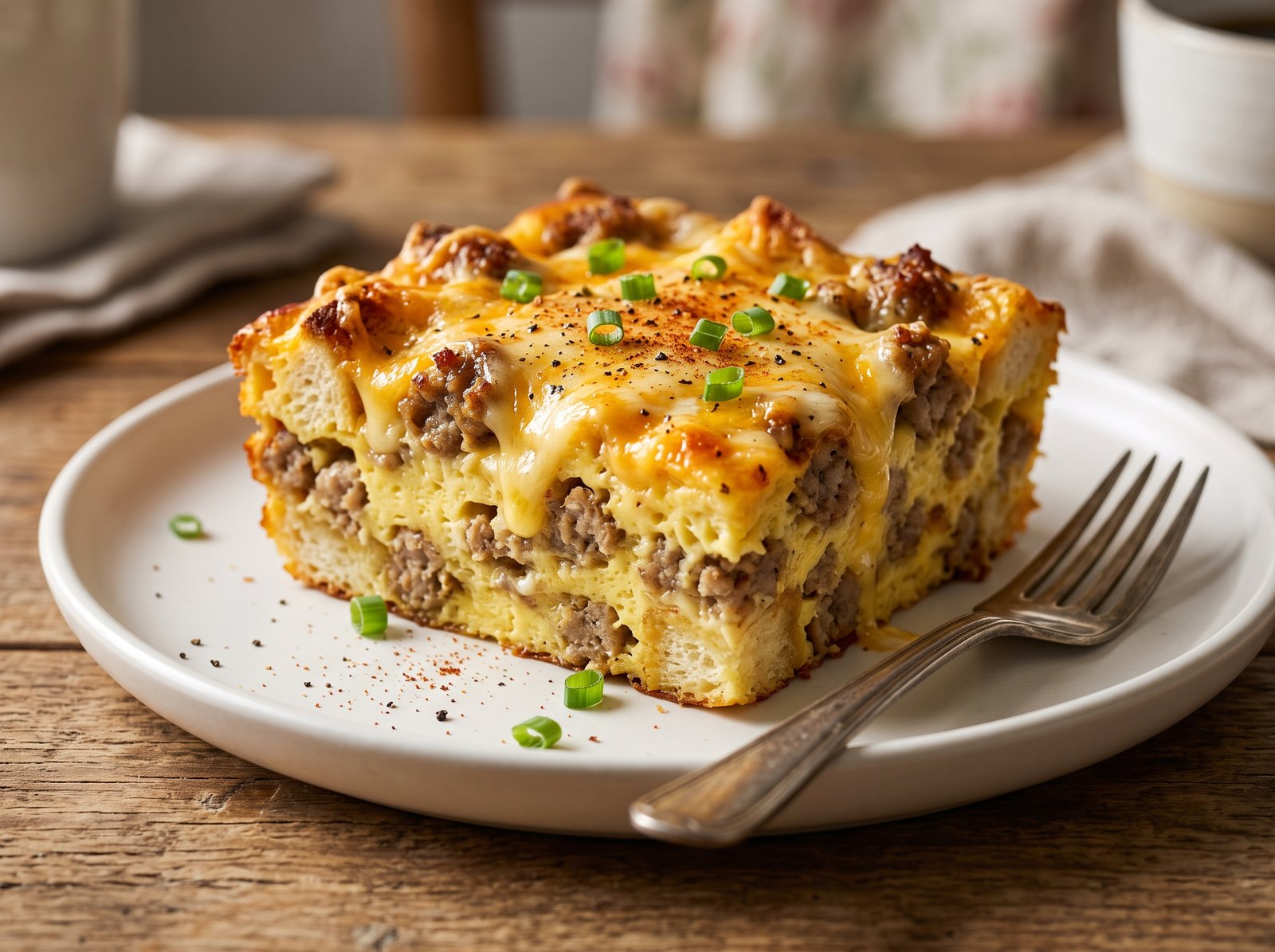
Sausage, Egg & Cheese Breakfast Casserole
Ingredients
Method
- Prep the bread: Cube the sourdough loaf and leave it exposed to ambient air for 24 hours to stale, or lightly toast it in a low-temperature oven to remove excess moisture.
- Cook the sausage: Heat a heavy-bottomed skillet over medium-high heat. Brown the sausage, breaking it into uniform morsels. Drain thoroughly on paper towels to remove all excess grease.
- Whisk the custard: In a large mixing bowl, combine the eggs, whole milk, dry mustard, garlic powder, onion powder, salt, and black pepper. Whisk vigorously until pale and highly aerated.
- Layer the ingredients: Lightly grease a 9×13-inch baking dish. Arrange the desiccated bread cubes across the bottom. Evenly distribute the browned sausage over the bread, followed by an even layer of the grated cheeses.
- Combine: Slowly pour the seasoned egg custard over the entire assembly. Gently press down on the solid components to ensure total submersion and hydration.
- Chill overnight: Tightly secure the baking vessel with plastic wrap and refrigerate for 4 to 12 hours so the bread acts as a sponge and absorbs the liquid.
- Bake: Let the chilled dish sit at room temperature for 30–45 minutes. Preheat your oven to 175°C (350°F). Bake uncovered for 45–55 minutes. If the top begins to over-brown, loosely tent the dish with aluminum foil.
- Finish: Verify doneness with a digital thermometer (the geometric center must reach 71°C/160°F). Garnish with freshly chopped scallions before serving.
Notes
- Grate your own block cheese for the smoothest melt.
- Refrigerate leftovers in an airtight container for 3–4 days.
-
Always fully bake the casserole before freezing.Rest the casserole for 10–15 minutes before slicing so the eggs fully set and cut into clean squares.
Part 3: Step-by-Step Guide to Assembling Your Sausage, Egg & Cheese Breakfast Casserole
Browning and Draining the Breakfast Sausage for Zero Excess Grease
The initial preparation of your protein is a decisive step in preventing a greasy, visually unappealing final product. I begin by heating a heavy-bottomed skillet over medium-high heat, allowing the ground meat to undergo intense caramelization through the Maillard reaction. It is imperative to break the meat into uniform morsels, ensuring even thermal distribution. Once thoroughly browned, I meticulously transfer the protein to a surface lined with absorbent paper towels. This crucial extraction of rendered fat prevents the lipids from rising to the surface during the final bake, guaranteeing a clean, appetizing presentation and superior texture.
Prepping the Bread: Why Stale or Lightly Toasted Bread Is Essential
Utilizing fresh, pliable bread is a fundamental error in strata construction. The moisture inherently present in a fresh loaf fundamentally rejects the absorption of the liquid egg mixture. Therefore, I strongly advise cubing your selected loaf and leaving it exposed to ambient air for twenty-four hours to facilitate staling. If time is a constraining factor, arranging the cubes on a sheet pan and subjecting them to a low-temperature oven effectively removes excess moisture. This controlled desiccation transforms the bread into highly efficient sponges, prepared to absorb the maximum volume of seasoned custard without structural collapse.
Whisking the Seasoned Egg-and-Milk Custard
Creating a homogenous liquid base requires vigorous mechanical agitation to properly denature the proteins prior to thermal application. In a voluminous mixing bowl, I combine the large farm-fresh eggs, whole milk, and precise measurements of dry ground mustard, garlic powder, and onion powder. Using a large balloon whisk, I incorporate air while aggressively blending the yolks and whites until the mixture achieves a uniform, pale yellow hue. This rigorous aeration is not merely aesthetic; it introduces microscopic air pockets that expand during the baking process, directly contributing to the signature fluffy egg texture we ultimately seek.
Layering Technique: How to Distribute Cheese, Bread, and Sausage Evenly
Proper stratification of ingredients ensures consistent flavor and texture in every individual portion of your Sausage, Egg & Cheese Breakfast Casserole. I initiate the assembly by lightly coating a 9×13-inch baking dish with a high-quality lipid to prevent adhesion. The foundational layer consists of the desiccated bread cubes, arranged to form an interlocking base similar to a croissant egg bake. Subsequently, I evenly disburse the browned meat over the carbohydrates, followed by a generous, uniform application of the grated dairy. Finally, I slowly pour the aerated liquid mixture over the entire assembly, gently pressing down on the solid components to guarantee total submersion and hydration.
Oven Temperatures, Bake Times, and Testing for Doneness with a Knife or Thermometer
Precision during the thermal processing stage separates a mediocre dish from a true culinary triumph. I preheat the oven to a moderate 350 degrees Fahrenheit, establishing an environment conducive to gentle, even coagulation. The baking duration typically spans forty-five to fifty-five minutes, depending on the initial temperature of the ingredients. To verify absolute doneness, I employ a digital probe thermometer; the internal temperature must reach exactly 160 degrees Fahrenheit to ensure both culinary safety and structural stability. Alternatively, inserting a paring knife into the center should yield a clean blade, indicating that the liquid proteins have fully set.
Part 4: Make-Ahead & Overnight Instructions for Stress-Free Mornings
How to Assemble the Sausage, Egg & Cheese Breakfast Casserole the Night Before
Implementing a deferred baking strategy is arguably the most intelligent decision a busy host can make. By executing the aforementioned layering techniques the preceding evening, you effectively shift the labor-intensive portion of the preparation to a more manageable timeframe. Once I have poured the liquid mixture over the solid ingredients, I tightly secure the baking vessel with a layer of impermeable plastic wrap to prevent atmospheric contamination and moisture loss. This prepared dish is then promptly relocated to the refrigerator, where the vital, slow-paced processes of hydration and flavor amalgamation can commence undisturbed while you peacefully rest.
Chilling Time: Why a 4- to 12-Hour Rest Improves the Bread’s Custard Absorption
The physics of capillary action require adequate time to function optimally within a culinary context. A minimum resting period of four hours is mandatory, though I strongly advocate for a full twelve-hour duration when feasible. During this extended refrigeration phase, the desiccated bread matrix acts as a capillary network, systematically drawing the seasoned liquid into its innermost chambers. If you bypass this crucial resting phase, the liquid will pool at the bottom of the vessel, resulting in a dual-textured failure: dry, toasted bread sitting precariously atop a dense, rubbery layer of aggressively cooked, unappealing scrambled eggs.
Taking the Chill Off: Crucial Baking Adjustments When Moving Directly from Fridge to Oven
Transitioning a dense, refrigerated mass directly into a highly heated environment demands careful thermal management to prevent catastrophe. Subjecting cold glass or ceramic directly to intense heat can induce thermal shock, potentially shattering the vessel. Therefore, I meticulously allow the dish to rest at ambient room temperature for approximately thirty to forty-five minutes prior to oven insertion. Furthermore, I recognize that the internal temperature of a chilled Sausage, Egg & Cheese Breakfast Casserole is significantly lower than a freshly prepared one, routinely necessitating an additional ten to fifteen minutes of baking time to achieve the required internal coagulation and safety metrics.
Part 5: Delicious Recipe Variations & Dietary Adaptations
Hash Brown Sausage, Egg & Cheese Casserole (Potato-Based Twist)
Substituting the traditional bread matrix with shredded tubers introduces a delightful textural divergence that appeals to many diners. By utilizing shredded hash browns or par-cooked tater tots as the foundational layer, the Sausage, Egg & Cheese Breakfast Casserole transitions away from a classic strata format. Much like substituting delicate pastries in a croissant breakfast casserole, using potatoes demands slightly more aggressive seasoning due to their inherent starch profile. This specific adaptation provides a wonderfully crispy exterior boundary while maintaining a soft, yielding interior, proving especially popular among those who prefer a heartier, diner-style aesthetic for their weekend morning provisions and gatherings.
Veggie-Packed Version: Adding Sautéed Bell Peppers, Spinach, and Mushrooms
Enhancing the nutritional density and chromatic appeal of this Sausage, Egg & Cheese Breakfast Casserole is easily accomplished through the strategic integration of vegetables. I frequently incorporate finely diced bell peppers, earthy mushrooms, and nutrient-rich spinach into the matrix. However, it is absolutely critical to aggressively sauté these botanicals prior to inclusion. Vegetables possess a high cellular water content; failing to extract this moisture through preliminary thermal processing will inevitably result in a compromised, weeping liquid structure within the final bake. Sautéing not only concentrates their distinct flavors but also fundamentally protects the delicate scientific balance of your carefully measured liquid ratio.
Low-Carb & Keto Adaptation: Fluffy Crustless Sausage and Egg Bake
Addressing specific metabolic requirements does not necessitate the sacrifice of culinary excellence. For individuals adhering to ketogenic or carbohydrate-restricted regimens, entirely omitting the bread matrix transforms the dish into an elegant, crustless quiche. Without the carbohydrates to absorb the liquid, I slightly increase the dairy fat content, utilizing heavy cream in place of whole milk to ensure a luxurious mouthfeel. This modification creates an intensely protein-forward and lipid-rich meal that satisfies strict dietary parameters while continuing to deliver the robust, savory satisfaction expected from a premium, thoughtfully prepared morning feast shared with cherished family and friends.
Gluten-Free Modifications: Breads and Flour-Free Thickeners That Hold Up
Accommodating celiac restrictions requires a nuanced understanding of alternative carbohydrate structures for a safe Sausage, Egg & Cheese Breakfast Casserole. Many commercially available gluten-free loaves lack the necessary protein network to withstand extended hydration, rapidly disintegrating into an unappealing mush. In my practice, I seek out artisanal gluten-free boules formulated with robust binders like xanthan gum or psyllium husk, which emulate the structural integrity of traditional wheat.
- Cassava flour bread: Offers excellent rigidity.
- Almond flour blends: Provide a nutty, dense crumb.
- Potato-based bases: Entirely circumvent the gluten issue.
When executing these modifications, I remain exceptionally vigilant to ensure all supplementary ingredients are certified free from cross-contamination.
Part 6: Pro-Chef Tips for a Fluffy, Golden-Brown Breakfast Bake
How to Prevent a Watery or Runny Casserole Center
Achieving a flawlessly set interior requires meticulous attention to both ingredient preparation and thermal application. A weeping, watery center is universally caused by either inadequate preliminary moisture extraction from vegetables and proteins, or a fundamentally flawed liquid ratio. I rigorously ensure that all supplemental ingredients are deeply caramelized and drained before assembly. Furthermore, removing the dish prematurely from the heat source halts the necessary protein coagulation. You must implicitly trust your digital thermometer; if the geometric center has not reached the critical threshold of 160 degrees Fahrenheit, the molecular structure simply has not stabilized, requiring further heat application.
The Foil Tent Method: Preventing Burnt Tops While Baking Thoroughly
Balancing a perfectly cooked interior with an aesthetically pleasing, golden-brown exterior presents a frequent challenge in deep-vessel cooking. Often, the exposed dairy and carbohydrate surfaces will rapidly over-caramelize and burn before the internal thermal target is achieved. To mitigate this discrepancy, I employ the foil tent method. Once the surface of your Sausage, Egg & Cheese Breakfast Casserole achieves the desired golden hue, I gently drape a loose piece of aluminum foil over the vessel. This technique reflects radiant heat away from the delicate surface while trapping steam and ambient heat, allowing the dense interior to finish cooking without compromising the visual appeal of the crust.
Resting Before Slicing: Why 10 Minutes Yields Clean, Picture-Perfect Squares
The exercise of culinary restraint immediately following the baking process is paramount for achieving professional presentation. While the olfactory temptation to immediately consume the dish is powerful, slicing into a boiling-hot matrix guarantees structural collapse. I mandate a minimum resting period of ten to fifteen minutes at ambient room temperature, identical to the resting period required for a delicate croissant egg bake. During this critical window, the residual kinetic energy dissipates, and the denatured proteins undergo a final firming process. This patience is tangibly rewarded when you apply your knife, yielding clean, mathematically precise, picture-perfect squares.
Serving Suggestions: Bright Sides, Hot Sauces, and Fresh Fruit Pairings
A substantial, lipid-rich main course demands highly acidic and refreshing accompaniments to achieve a balanced palate experience. I traditionally serve this commanding Sausage, Egg & Cheese Breakfast Casserole alongside a vibrant, citrus-dressed arugula salad, which provides necessary botanical bitterness and acidity to cleanse the sensory receptors. Additionally, presenting a curated selection of artisanal hot sauces allows guests to customize their thermal and acidic inputs. To finalize the presentation, a beautifully composed platter of seasonal fresh fruit—specifically tart berries or melon—offers a contrasting temperature and natural sweetness, ensuring the overall meal feels comprehensive, elegant, and nutritionally varied for all your esteemed guests.
Part 7: Storage, Freezing, and Reheating Instructions
How to Store Leftovers in the Refrigerator Safely
Proper management of culinary surplus ensures the extended viability of your initial labor investment. Once the remaining portions have completely cooled to ambient room temperature—thereby preventing the formation of condensation that causes bacterial proliferation—I transfer the squares into hermetically sealed glass containers. Stored in the deepest, coldest sector of the refrigerator, these leftovers maintain optimal safety and sensory quality for three to four days. I strictly advise against leaving the vessel at room temperature for extended durations, as the high protein and moisture content creates an ideal environment for rapid and dangerous microbial development.
Can You Freeze Breakfast Casserole? (Freezing Before vs. After Baking)
Preserving your Sausage, Egg & Cheese Breakfast Casserole via freezing requires an understanding of cellular expansion and contraction. While some advocate freezing the unbaked matrix, I find this often results in severe structural degradation upon thawing. Much like attempting to freeze an unbaked ham and cheese casserole, the ice crystals rupture the soaked bread cells. Instead, I heavily endorse baking the dish completely before executing the freezing protocol. Once thoroughly cooled, I meticulously wrap individual portions tightly in plastic wrap, followed by a secondary layer of heavy-duty aluminum foil to completely inhibit freezer burn. These portions remain viable for up to two months.
Reheating Single Slices vs. Full Casseroles Without Drying Out the Eggs
The methodology employed during the reheating phase dictates whether your leftovers remain luxurious or devolve into desiccated, unpalatable ruins. For single, individually wrapped portions, I utilize the microwave, employing a damp paper towel drape and a reduced power setting to gently reintroduce thermal energy without aggressively tightening the protein structures. When faced with the necessity of reheating an entire Sausage, Egg & Cheese Breakfast Casserole, the oven is the only acceptable apparatus. I introduce a marginal splash of whole milk, tightly secure a foil cover to trap steam, and slowly heat at 300 degrees Fahrenheit until gently warmed throughout, preserving the delicate textures.
ly secure a foil cover to trap steam, and slowly heat at 300 degrees Fahrenheit until gently warmed throughout, preserving the delicate textures.rmed throughout, preserving the delicate textures.
F&Q
Why is my Sausage, Egg & Cheese Breakfast Casserole soggy or watery in the middle?
A soggy interior is a direct consequence of excess internal moisture disrupting the delicate protein-to-liquid ratio. In my extensive testing, this flaw almost universally stems from failing to utilize adequately desiccated bread, or neglecting to aggressively extract the natural water content from incorporated vegetables and meats prior to assembly. If the structural carbohydrates are already saturated with their own inherent moisture, they simply cannot absorb the seasoned egg mixture. To rectify this, ensure your bread is properly staled, and always deeply sauté and drain any supplementary ingredients to maintain the scientific integrity of your carefully balanced recipe.
Do you bake the Sausage, Egg & Cheese Breakfast Casserole covered or uncovered?
The decision to utilize a cover during the thermal application phase is highly dependent on your specific oven environment and visual preferences. My professional protocol dictates initiating the baking process completely uncovered. This exposure facilitates the necessary evaporation of surface moisture, promoting the development of a structurally sound, deeply caramelized, and visually appealing upper crust. However, I remain highly vigilant. The moment the surface achieves optimal golden-brown aesthetics, I promptly implement the foil tent method. This strategic adaptation protects the delicate dairy proteins from scorching while ensuring the dense internal matrix achieves absolute thermal safety and stability.
Can you freeze a Sausage, Egg & Cheese Breakfast Casserole before or after baking?
When managing advanced meal preparation, the timing of your freezing protocol profoundly impacts the final texture of your Sausage, Egg & Cheese Breakfast Casserole. As previously analyzed, I staunchly recommend executing the freezing process only after the dish has been fully baked and subsequently cooled to ambient room temperature. Freezing an unbaked, fully hydrated matrix promotes the formation of massive ice crystals within the bread cells. Upon thawing, these ruptured cells release their trapped liquid, invariably resulting in a compromised, weeping structure that is texturally inferior. Fully cooking the proteins stabilizes the matrix, allowing remarkable integrity post-thaw.
Disclaimer:
The culinary and nutritional information provided in this article is strictly for educational and informational purposes only. It does not constitute professional medical advice, diagnosis, or treatment. While I strive to provide accurate macronutrient insights and dietary substitution recommendations, these should not replace consultations with qualified healthcare professionals. Always consult your physician before making significant changes to your diet, especially if you manage specific metabolic conditions. Any claims regarding nutritional benefits are substantiated by general culinary science but are not intended as clinical guidelines.